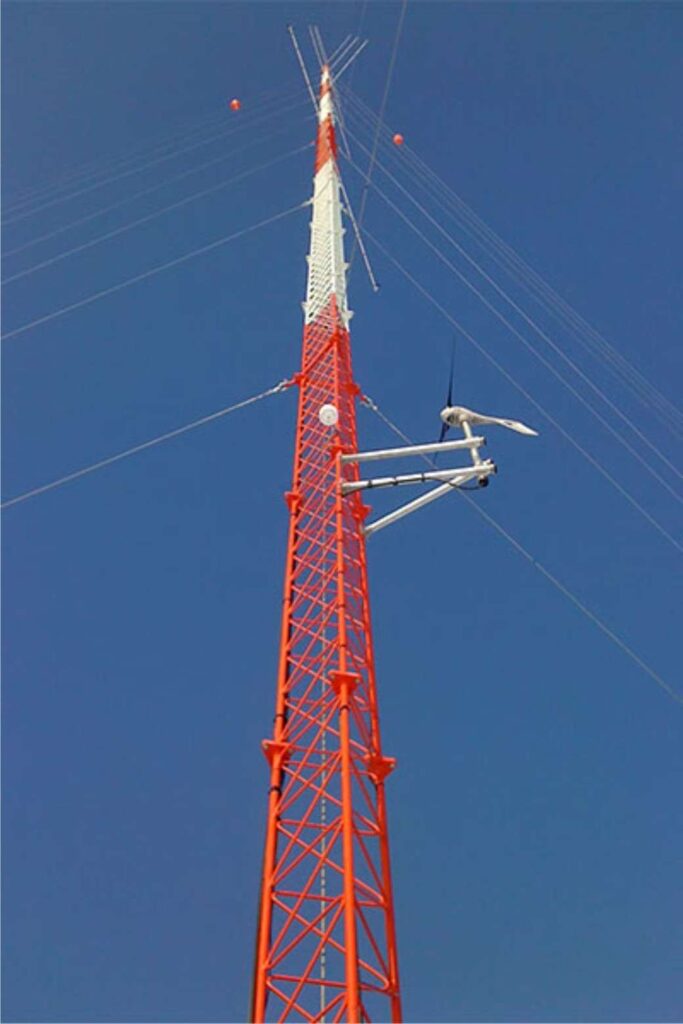
- Guyed masts are the most economical way to reach height when land is available.
- Self-supporting lattice towers carry heavy antenna and microwave loads on a compact footprint.
- Monopoles and rooftop poles suit cities where space and appearance matter.
Pakistan’s mobile networks run on thousands of towers, and operators keep adding sites as data demand grows and new spectrum is rolled out. Choosing the right tower type affects land cost, approval effort, installation time and how many antennas the site can carry in future.
Guyed masts
A guyed mast is a slender lattice column held upright by steel guy wires anchored to the ground at several points around it. Because the wires take the lateral loads, the mast itself can be light, making guyed masts the cheapest way to reach significant height. The trade-off is land: anchors sit some distance from the base, so the site needs a large plot. They are common in rural areas, along highways and for radio, wireless internet and monitoring applications.
Self-supporting lattice towers
Three- or four-legged lattice towers stand on their own foundations without guys. They are stiff and strong, carry many antennas and large microwave dishes, and are easy to climb and extend. The footprint is far smaller than a guyed mast, though foundations and steel weight are higher. They are the workhorse for macro sites shared by more than one operator.
Monopoles
A monopole is a single tapered tubular or polygonal steel pole. It needs the least ground space and looks tidier in towns, but uses more steel per metre of height than a lattice tower and is harder to strengthen later. Monopoles suit urban and suburban sites, highways with limited right of way and campuses.
Rooftop poles and towers
In dense cities, short poles or small lattice towers are mounted on building roofs. The structure is light, but the building’s capacity to carry the extra load and the fixing details must be checked by a structural engineer.
Comparison
| Type | Footprint | Antenna load | Best for |
|---|---|---|---|
| Guyed mast | Large | Light to medium | Rural, economical height |
| Lattice tower | Medium | Heavy | Shared macro sites |
| Monopole | Small | Light to medium | Urban, roadside |
| Rooftop pole | On building | Light | Dense city centres |
Design points that matter
- Wind and antenna area: each antenna, dish and cable tray adds wind load. Design for future equipment, not just day one.
- Twist and sway limits: microwave links need a stiff tower to stay aligned.
- Foundations: soil type decides pad, pile or raft foundations.
- Corrosion: hot-dip galvanizing is standard for tower steel and bolts.
- Climbing and safety: ladders, fall arrest, platforms and aviation lighting where required.
Apex Engineers fabricates guyed masts and lattice poles in our Lahore manufacturing facility. Tell us the height, antenna loading and site and we will propose the right structure.

Written by the Apex Engineers team
Engineers and fabricators at Apex Engineers (Pvt.) Limited, building fuel stations, storage tanks, steel structures, towers and road safety systems from our Lahore manufacturing facility since 1992. About us
Related articles
 Towers & road safety
Street Light Poles: Heights, Shapes and Galvanizing Explained
Read article Towers & road safety
Road Signs in Pakistan: Reflective Sheeting, Structures and Safety
Read article Fuel stations & tanks